Public Works Needs to Design Brighton Boulevard With the Future in Mind
In an open letter posted on WalkDenver’s website yesterday, Joel Noble challenged the Department of Public Works and their consultants to be bold while redesigning Brighton Boulevard for walking, biking, and transit. Noble wrote as a resident, but he is also a Planning Board member, the president of Curtis Park Neighbors, and co-chair of the INC Transportation Committee. (Full disclosure: he has donated to Streetsblog Denver.) Noble’s critique hit the nail on the head.
From the commentary:
…In the proposed design presented at the June 18th public meeting, the sidewalks are quite narrow – as little as five feet wide in many areas – and therefore unlikely to support lots of two-way pedestrian activity. Given that the downtown sidewalk standard is 16 feet, does this Brighton Boulevard design really create the walkable, accessible environment we desire?
Noble makes a great point about the disparity in sidewalk width. The Brighton corridor will morph from a yawning industrial zone near downtown into a lively, walkable neighborhood — but only if it gains legitimate walking infrastructure. Brighton’s design should reflect its urban potential, not its industrial past.
Even if the posted 35 mph speed limit isn’t lowered (it doesn’t look likely), we know that drivers go as fast as they feel comfortable going. Some lanes will be 11 feet wide, according to design documents, a width that leads to higher driving speeds than 9- or 10-foot wide lanes, which are preferable for city streets. Wide lanes contribute to high speeds that already are a concern on Brighton, which planners insist must cater to commercial trucks zooming to and from I-70.
As Noble points out, that might change, and Denver needs to be proactive instead of reactive:
As the years go by the character of the area will likely change, with much more pedestrian activity along the corridor and moving between destinations on both sides of the street, which will elevate the safety discussion and put a spotlight on sidewalk width, vehicle speeds (related to lane width), and pedestrian crossing distances.
If, in the future, there is a community desire to reduce the width or number of the general travel lanes, unless the edge of the elevated cycle track could move to “shrink” the general roadway, the reclaimed space would likely only be able to be put to some use with limited benefit, such as widening the median. The ability for the design to meaningfully evolve would be limited.
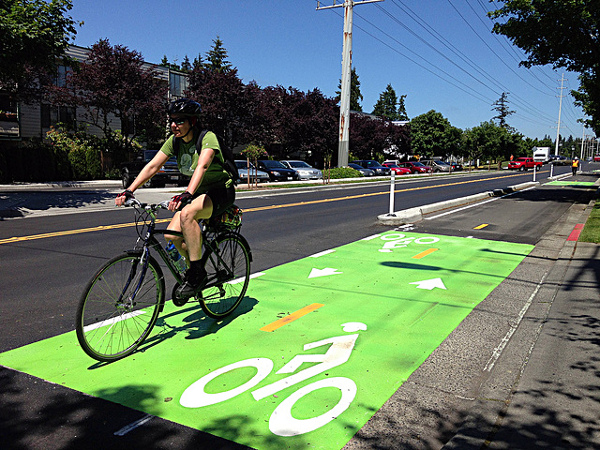
To allow flexibility for future road diets, Noble suggests using modular curbs (pre-formed, movable curbs) and vertical separators to protect the bike lane, instead of more permanent materials. That way, in 20 years (hopefully fewer) when planners question the logic of a four-lane arterial spearing through an active urban street, they can easily narrow the road, widen the sidewalks, and expand the bike lane.
“Be bold,” Noble writes. “This project deserves it, and everyone is watching.”
Head over to WalkDenver’s website to read the whole commentary. It’s well worth it.
Streetsblog has migrated to a new comment system. New commenters can register directly in the comments section of any article. Returning commenters: your previous comments and display name have been preserved, but you'll need to reclaim your account by clicking "Forgot your password?" on the sign-in form, entering your email, and following the verification link to set a new password — this is required because passwords could not be carried over during the migration. For questions, contact tips@streetsblog.org.