Traffic Fiasco at Uber Employee Party Highlights Why Ride-Hailing Is Awful for Cities
It’s becoming increasingly obvious that ride-hailing services like Uber and Lyft aren’t the solution for better urban transportation. Rather, they represent a a huge problem for cities trying to provide a safe, efficient, equitable, and environmentally friendly transportation network for their residents.
Yes, there are upsides to ride-hailing. The technology can make living without a car more convenient, it provides a new travel option in underserved neighborhoods with subpar transit and taxi access, and it helps keep intoxicated drivers off the road.
But there are many serious downsides to Uber and Lyft. They’re dramatically increasing the amount of miles driven in cities, partly because their drivers spend half their time “deadheading,” cruising around with no passengers. That extra traffic increases the number of crashes, as well as congestion, which slows down buses.
Meanwhile, Uber and Lyft’s artificially-cheap service, propped up by wealthy investor’s venture capital money is cannibalizing public transportation. The reduced ridership and fare box revenue makes it more difficult for transit agencies to provide frequent, reliable, 24/7 service, which leads to more ridership losses, creating a vicious cycle.
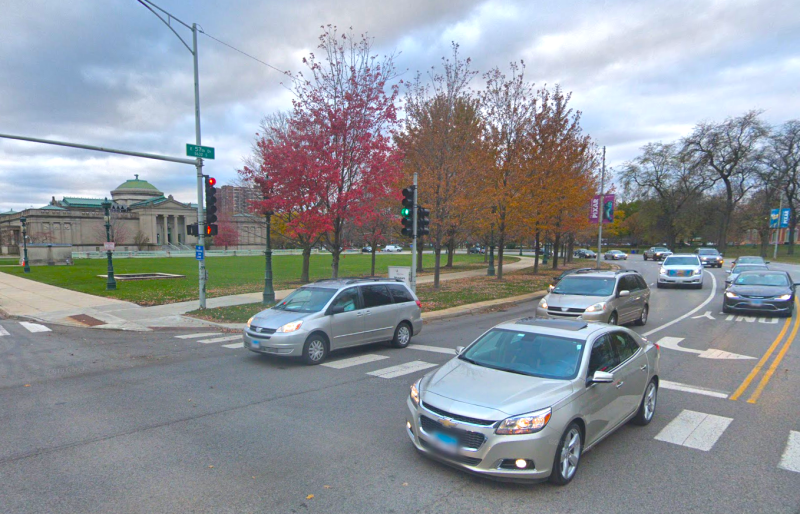
The absurdity of the the ride-hailing model, in which everyone who possibly can takes a car to urban destinations, was laid bare during a disastrous Uber employee appreciation party Monday night at Chicago’s Museum of Science and Industry in the dense Hyde Park neighborhood. As reported by the Chicago Tribune’s Alice Yin, the ride-hailing company hosted the shindig at 6:30 p.m.
John Morrison, who had been invited to the party by a friend who drives for Uber, said he saw got stuck in a massive traffic jam of cars with ride-hailing decals in east Hyde Park on his way to the event. A location where 57th Street and Cornell Drive merge was complete chaos, he said, because some drivers were going the wrong way and were facing other motorists bumper-to-bumper.
S Cornell Drive is entirely backed up with cars driving the wrong directions in both lanes because every damn @Uber driver in the city is headed into @msichicago because Uber promised them free admission and food / drinks for them and their families.
— John Morrison (@localcelebrity) June 10, 2019
Morrison said it took him almost an hour to drive the single mile from Lake Shore Drive’s 53rd Street exit to the MSI. Once he got there, the museum’s massive 1,500-car underground parking garage was over-capacity. The Uber drivers had been promised free parking.
A massive traffic jam filled entirely with @Uber drivers trying to get into a overfilled parking garage to get free stuff is the embodiment of the late-stage capitalist nightmare that is Uber.
— John Morrison (@localcelebrity) June 10, 2019
Eventually, Uber texted its drivers a notification that the party was full. “Due to overwhelming response, the Museum of Science and Industry is at capacity and is not able to accept any more guests,” the text read. “We are sorry for the inconvenience.” The event ended 30 minutes before the scheduled time.
While the party planners made other logistical mistakes, their main ones was assuming that it would work for thousands of people to show up at the same time at the same location in a congested urban neighborhood via cars. Large metal boxes that only hold a handful of passengers are simply not a space-efficient way to move people through cities, which is a big part of why the ride-hailing boom is causing such havoc.
At least one party guest noted that Uber could have helped prevent the horrible traffic jam that clogged the streets of Hyde Park if they’d recommended that people take the convenient CTA bus or Metra commuter rail service to the museum.
Wouldn’t want anyone to know about mass transit options or anything. I was walking and getting ahead of cars by blocks.
— Dean W. Armstrong (@dwarmstr) June 11, 2019
But, hey, encouraging people to take transit instead of cars wouldn’t be in keeping with Uber’s (completely unsustainable) business model, would it?
Streetsblog has migrated to a new comment system. New commenters can register directly in the comments section of any article. Returning commenters: your previous comments and display name have been preserved, but you'll need to reclaim your account by clicking "Forgot your password?" on the sign-in form, entering your email, and following the verification link to set a new password — this is required because passwords could not be carried over during the migration. For questions, contact tips@streetsblog.org.