All the Bad Things We’re Learning about Uber and Lyft — Listed
This week the Daily Bruin, UCLA’s student newspaper, wrote that students at that school are taking an astonishing 11,000 Uber and Lyft trips every week that both begin and end within the boundaries of the campus.
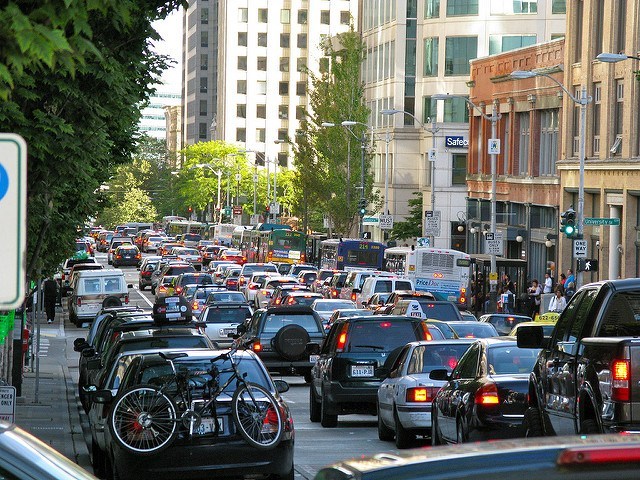
It was the latest evidence that Uber and Lyft are massively increasing car trips in many of the most walkable and transit friendly places in U.S.
A raftof recentstudieshave found negative effects from Uber and Lyft — everything from increased congestion, to higher traffic fatalities, to huge declines in transit ridership. It’s becoming more and more clear that Uber and Lyft having some pretty pernicious effects on public health and the environment, especially in some of the country’s largest cities.
We decided to compile it all into a comprehensive list, and well, you judge for yourself. Here we go:
#1. They increasing driving — a lot
The UCLA trips are just the tip of the iceberg and warn of what is happening at a much wider scale: A lotmore driving.
Uber and Lyft are, for example, providing 90,000 rides a day in Seattle now. That’s more than are carried daily by the city’s light rail system, the Seattle Timesreports.
One studyestimated that in cities with the highest Uber and Lyft adoption rates, driving has increased about 3 percent compared to the cities with the lowest. That’s an enormous, enormous amount of miles.
Transportation consultant Bruce Shaller estimates they added 5.7 billion driving miles in the nine major cities they primarily operate. (For comparison, in their first year of deployment across the U.S., e-scooters operated by private tech firms carried between 60-80 million trips.)
By the end of this year, Shaller has estimatedUber and Lyft will surpass the number of trips made on buses the U.S.
#2. They spend half their time “deadheading”
It’s important to understand, that for every mile a Uber or Lyft car drives with a passenger it spends almost as many miles — if not more — circling without passengers. In the industry this is called “deadheading.” Different studies have made different estimations. But estimates varyfrom between 30 percent at the low end and as much as 60 percent at the high.
Uber and Lyft’s policies make this worse by encouraging drivers to constantly circle to reduce wait times for users, according to John Barrios, a researcher at the University of Chicago who has studied Uber and Lyft.
#3. They draw their customers from the most transit friendly areas
A lot of people will argue that Uber and Lyft show we need to beef up our transit service in the United States. And we doneed to beef up transit service in the U.S.
But Uber and Lyft operate primarily in the areas of the country that are bestserved by transit. For example in Seattle, about half the rides taken in Uber and Lyft originate in just four neighborhoods: downtown, Belltown, South Lake Union and Capitol Hill. These are some of the city’s most walkable and best-served as far as transit.
Moreover, according to Shaller, about 70 percent of Uber and Lyft trips take place in just nine American cities: Boston, Chicago, Los Angeles, Miami, New York, Philadelphia, San Francisco, Seattle and Washington, D.C. Meanwhile, traditional taxi service, Schaller estimates, still serve more total trips in suburban and rural areas than TNCs.
#4. They hoard their data
One qualification with this lis:. Much of the information we have about Lyft and Uber is imperfect. The two companies make it difficult to study the social impacts of their activities because they jealously guard their data.
Last year when Barrios released a studyshowing a lot of negative impacts from Uber and Lyft, Lyft corporate attacked the study calling it “deeply flawed.”
Barrios had to use Google search numbers to estimate Uber and Lyft penetration in certain markets because even academic researchers just don’t have access to Uber and Lyft trip data. If Uber and Lyft are honest in their denials of social harms, releasing their could help disprove it. But so far they have mostly refused.
#5. They mostly replace biking, walking or transit trips
In an ideal world — and many people expected — Uber and Lyft would “free people from cars.” City dwellers would feel more comfortable selling their cars thanks to the presence of Uber and Lyft.
But the data shows that Uber and Lyft mostly “free” people from walking and transit.
A surveyof 944 Uber and Lyft riders by the Metropolitan Area Planning Council in Boston last year, found that 42 percent of riders would have taken transit instead if the services hadn’t been available. Another 12 percent said they would have biked or walked their journey. Another 5 percent would have just avoided the trip altogether.
Only about 17 percent — less than one in five — said they would have made the journey in a private car otherwise. The rest said they would have used a traditional taxi. Uber and Lyft just aren’t competitive with private car ownership, Schaller said, except in areas with expensive parking or when drunk driving is difficult to avoid.
Even with Uberpool and other shared services — which account for a small share of total business, Shaller says Uber and Lyft increase car miles on urban streets. For each mile of driving removed, they add about 2.6 miles, he estimates.
#6. They cater to affluent people
Some studies have said different things. But on average, Uber and Lyft riders, not surprisingly, skew rich and skew young.
In the top nine cities for Uber and Lyft people with incomes above $200,000 are by far the most likely to take advantage. Lower-income people without cars in some less urban markets do use Uber and Lyft but their use is dwarfed by that of those living in major cities with high incomes, Schaller finds.

#7. They hurt transit
Uber and Lyft are just crushing transit service in the U.S. A recent study estimated, for example, they had reduced by ridership 12 percent over the last ? years. And each year the effect grows.
Every person lured from a bus or a train into a Lyft or Uber adds congestion to the streets and emissions to the air. Even in cities that have made tremendous investments in transit — like Seattle which is investing another $50 billion in light rail — Uber and Lyft ridership recently surpassed light rail ridership.
Transit agencies simply cannot complete with private chauffeured driving service which is subsidies at below real costs by venture capitalists. And maybe that’s the point.
#8. They reduce political support for transit expansion
If relatively well-to-do people can hop in an Uber or a Lyft every time the bus or trail is 20 minutes late, it reduces political support for transit expansion. The wealthier people substituting Uber and Lyft for transit trips have disproportionate political influence. Dampened political pressure for transit investment from this group undermines services lower-income people rely on.
In addition, right wing ideologues have arguedthat Uber and Lyft make transit investment unnecessary.
#9. They create a socially stratified transportation system
Relatively well off people in Ubercars congesting the streets of Manhattan and San Francisco slow down buses full of relatively low-income people. By giving people who can afford it escape from the subway, Uber and Lyft also reduce social interaction between people of different classes and a more stratified society.
#10. They encourage people to buy cars
Uber and Lyft — the conventional thinking was — were going to “free” city dwellers to sell their cars. There is some evidence they have done that — for higher income groups. However, the University of Chicago studyfound the presence of Uber and Lyft in cities actually increases new vehicle registrations. That’s because they encourage lower-income people who work as drivers to purchase cars. We shouldn’t be too surprised about this. Uber actually advertises in some markets that people should buy cars in order to work as drivers.

#11. They increase traffic fatalities
The University of Chicago study mentioned earlier estimated that Uber and Lyft increased traffic fatalities last year by an astonishing 1,100 — an enormous human toll. The study also found, surprisingly, that Uber and Lyft have no effect on drunk driving.
In addition, Uber and Lyft require basically no safety training for their drivers at all. In fact, the presence of these companies has motivatedcities like Toronto to eliminate safety training requirements the city previous required for taxi drivers, in order to ostensibly level the playing field.
Other problems
These are just the transportation related drawbacks. We didn’t even get into their treatment of employees, their un-competitive duopoly over the market, the questionable behavior of their leadership and many other issues these companies raise.
To top it all off, the companies don’t even make money. Uber lost a billion dollarsin a single quarter in 2018. It has never turned a profit.
Streetsblog has migrated to a new comment system. New commenters can register directly in the comments section of any article. Returning commenters: your previous comments and display name have been preserved, but you'll need to reclaim your account by clicking "Forgot your password?" on the sign-in form, entering your email, and following the verification link to set a new password — this is required because passwords could not be carried over during the migration. For questions, contact tips@streetsblog.org.