Denver’s Unwalkable Rail Network, Visualized
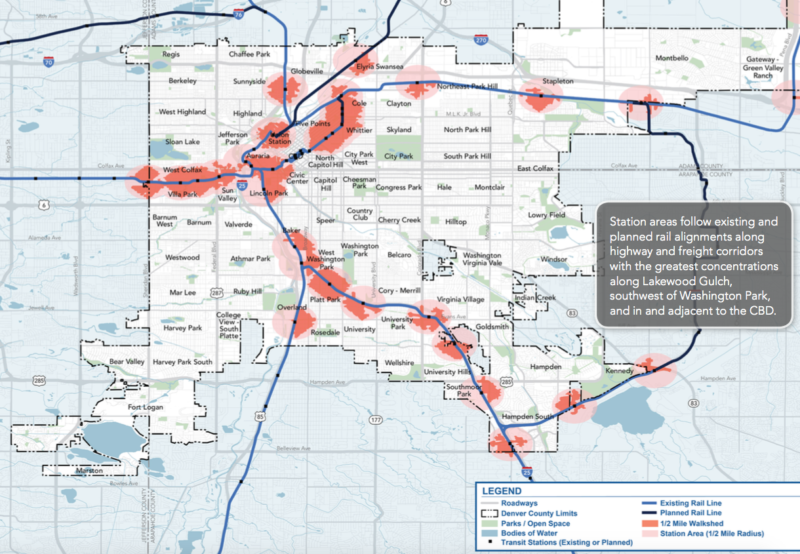
In order for places to maximize the value of transit, they have to be walkable. Once people can safely and conveniently walk to the train or the bus, all the other benefits of transit fall into place — less traffic, compact development with shorter distances to travel, active transportation instead of sedentary lifestyles, and neighborhoods with more street life and social interaction.
Denver could use its transit system to deliver all these benefits, but the way RTD’s rail system is set up undercuts that potential. Part of the reason is that our frequent, dependable rail services don’t always serve population centers.
Only 8 percent of Denverites live within a half-mile of a rail station — about a 10-minute walk — “despite growth in rail transit in Denver over the last 15 years,” according to new data out of the Denveright planning process. Just 24 percent of Denver residents work near a rail stop.
Transit is most effective when it serves dense clusters of housing and jobs. That’s the key to making transit an appealing choice to the greatest number of people. Unfortunately, many of Denver’s RTD stations aren’t in dense neighborhoods — they’re along highways, major roads, and in industrial areas. In many cases they’re most easily accessible by car. RTD’s mostly free park-and-ride lots add even more incentive to drive.
In the map above, the circles around each station represent the area that should be within walking distance — if the streets were laid out optimally. But only the darkly shaded areas are actually within a 10-minute walk of the train. Around many stations, most of the area that should be walkable is instead hostile territory for people on foot, thanks to barricades like parking lots, highways, and industrial land use.

Instead of anchoring walkable neighborhoods, too many of our rail stations are built next to inhospitable highways and sprawling parking lots, along sparsely populated driving corridors. RTD and city leaders made these siting decisions a long time ago, and they’re now playing catch-up with development. The Denveright planning process should shape that development by setting the stage to build many more homes for people of all income levels near transit.
The good news is that Denver has real strengths to build on. The rail expansion is introducing more people to transit, and we have some corridors with good, high-frequency service. As you can see in the second map, these aren’t just rail lines — many people ride transit on well-served bus corridors like Colfax Avenue.
What we need are more streets with frequent bus service, and to prioritize bus riders by dedicating exclusive lanes for transit on city streets.
Denver can be a great transit city if we develop walkable places around our new rail stations and bring fast, high-frequency bus service to more neighborhoods.
Streetsblog has migrated to a new comment system. New commenters can register directly in the comments section of any article. Returning commenters: your previous comments and display name have been preserved, but you'll need to reclaim your account by clicking "Forgot your password?" on the sign-in form, entering your email, and following the verification link to set a new password — this is required because passwords could not be carried over during the migration. For questions, contact tips@streetsblog.org.