Feds Will Investigate Charge That CDOT’s I-70 Widening Violates Civil Rights
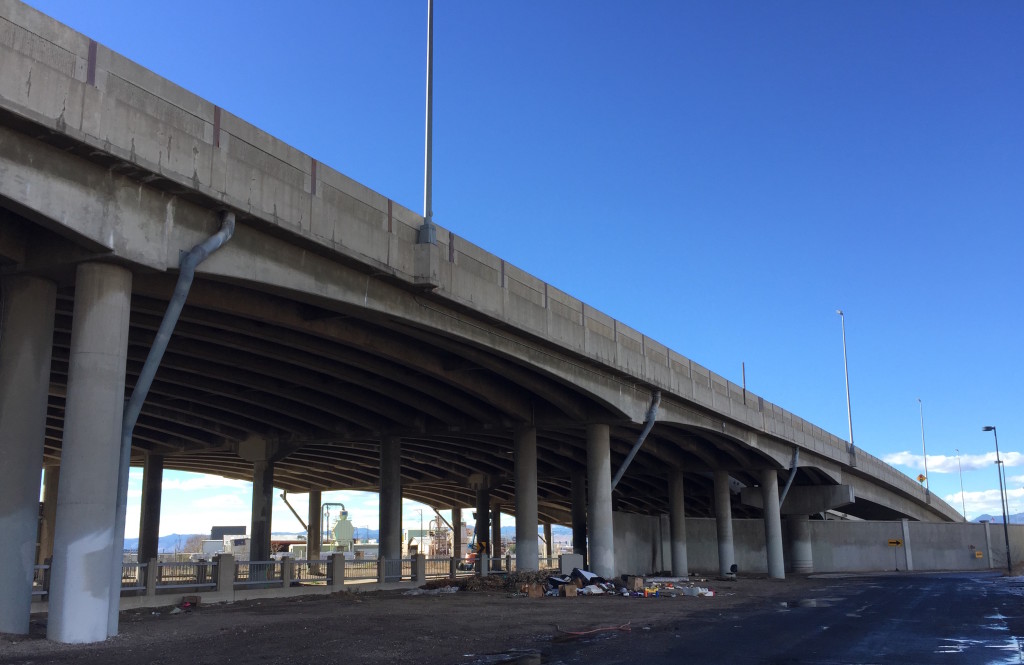
The Federal Highway Administration will follow-up on a civil rights complaint against CDOT’s massive I-70 expansion through north Denver that opponents of the project filed last month [PDF].
FHWA will now determine whether the project will have a disparate impact on Denver residents who have historically been disadvantaged because of their race or ethnicity.
The people who live and own businesses near I-70 are mostly low-income and mostly Latino. Members of the Elyria and Swansea Neighborhood Association, the Colorado Latino Forum, and the Cross Community Coalition say these neighborhoods have borne the brunt of the highway’s presence since the 1960s, and will continue to pay the price if CDOT triples the size of the road as planned.
If FHWA finds that the I-70 widening would have a disparate impact, the agency could take steps to rectify the situation, including revoking federal funds for the project. FHWA could also make federal funding conditional on CDOT considering a different option, like re-routing the highway along I-270 and I-76.
“We want the investigation to really reveal what makes the most sense,” said Joel Minor, an attorney with Earthjustice working on behalf of north Denver residents. “The fact that at the end of the investigation, the U.S. Department of Transportation could make a formal finding of discrimination and cut off federal funds, is obviously an incentive to bring the Colorado Department of Transportation to the bargaining table and to really explore those alternatives and mitigation measures in a more meaningful way than I think has been explored in the environmental impact statement process to date.”
Ideally FHWA would facilitate meetings between CDOT and neighborhood residents, Minor said. After years of neighborhood highway opponents getting stonewalled by state and city officials, it looks like they will finally have the ear of federal investigators.
“For us, what this means is that there’s somebody who’s actually going to step in and come pay attention,” said Candi CdeBaca, founder of the Cross Community Coalition.
I-70 has already has imposed health problems and economic hardships on the predominantly Latino community. Globeville, Elyria, and Swansea residents are subject to elevated rates of cardiovascular disease and asthma, according to the Office of Environmental Health [PDF].
“So tripling the size of this highway that created those violations in the first place is not going to alleviate those conditions — it’s going to exacerbate them,” CdeBaca said. The fact that the 40-foot I-70 trench will have to be carved out of a Superfund site (land identified by the EPA as contaminated) doesn’t help CDOT’s case either.
One wildcard during the process will be the effect of the presidential transition. While the investigation will be initiated by FHWA under Transportation Secretary Anthony Foxx, who has spoken out against urban highways, it will probably conclude after Donald Trump is sworn in as president.
Streetsblog has migrated to a new comment system. New commenters can register directly in the comments section of any article. Returning commenters: your previous comments and display name have been preserved, but you'll need to reclaim your account by clicking "Forgot your password?" on the sign-in form, entering your email, and following the verification link to set a new password — this is required because passwords could not be carried over during the migration. For questions, contact tips@streetsblog.org.