Research Explains Why Pedestrians ‘Break the Rules’
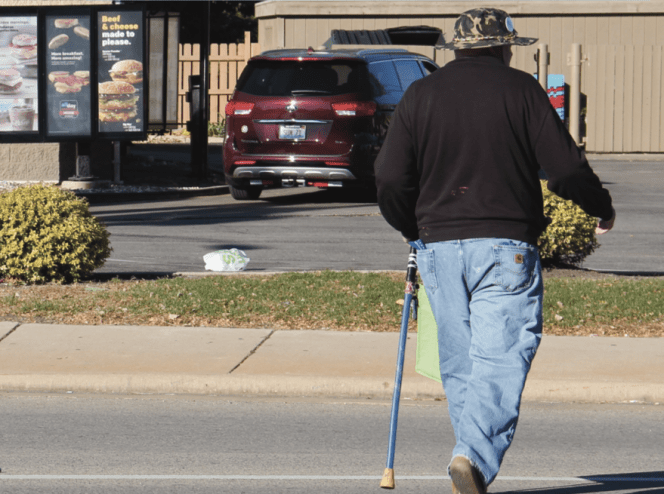
A man in wheelchair rolls up to the crosswalk at State Street in Rockford, Ill.
He sees there is no ADA ramp, stops, and then turns around. He rolls down a driveway and then into the street. Briefly mixing with traffic, he rolls around the curb and back onto the crosswalk.
This tiny failure was one of hundreds of captured by University of Illinois master’s student Michael Smith showing how pedestrians interact with drivers and the infrastructure along a dangerous stretch of State Street. The clips were recorded by time-lapse camera at three locations as part of his master’s thesis [PDF].
When pedestrians are hurt or injured, there’s a reflexive impulse in America to blame them, for jaywalking, or for being distracted.
But Smith’s videos found pedestrians’ behavior is influenced a lot by the environment: They’re more likely engage in risky behavior — like walking or rolling in the street or crossing mid-block — when the pedestrian infrastructure is incomplete or lacking.
At that particular intersection on State Street, the same thing happened over and over again. The non-ADA complaint crosswalk was near a housing complex for people 55 and older, Smith says.
“None of the people was using the designated crossing ramp,” Smith told Streetsblog. “They went on the roadway.”
[youtube https://www.youtube.com/watch?v=SaI9zY08Vq0]State Street is the most dangerous road in Rockford. About 22 percent of all pedestrian collisions between 2007 and 2016 occurred on this street.
The three locations filmed by Smith on State Streets were fairly typical of many locations around the nation: there weren’t complete sidewalks or even “Walk” signals and many of the stop lights were too far from the next signal.

“”It’s not so much a failure on behalf of either mode but a land use failure,” he said. “Bus stops are usually just a sign on a lamp post. There’s no benches or shelters.”
People were adapting their behavior to the conditions, often in ways that put them at risk. He noticed, for example, people waiting for buses would often wait at the nearest retail location.
“And then the moment a bus would come, you’d see a mid block crossing, running across the street,” he said.
Smith didn’t see any pedestrians injured during his one month of filming, but he did make some recommendations to improve safety, including reducing the speed limit from 30 to 25 mph, adding zebra-striped, high-visibility crosswalks, adding pedestrian leading intervals at traffic signals, and doing ADA upgrades.
Streetsblog has migrated to a new comment system. New commenters can register directly in the comments section of any article. Returning commenters: your previous comments and display name have been preserved, but you'll need to reclaim your account by clicking "Forgot your password?" on the sign-in form, entering your email, and following the verification link to set a new password — this is required because passwords could not be carried over during the migration. For questions, contact tips@streetsblog.org.